![Recare [logo]](https://www.recare.co.uk/wp-content/themes/recare-theme-2021/assets/img/recare-logo-no-strap.svg)
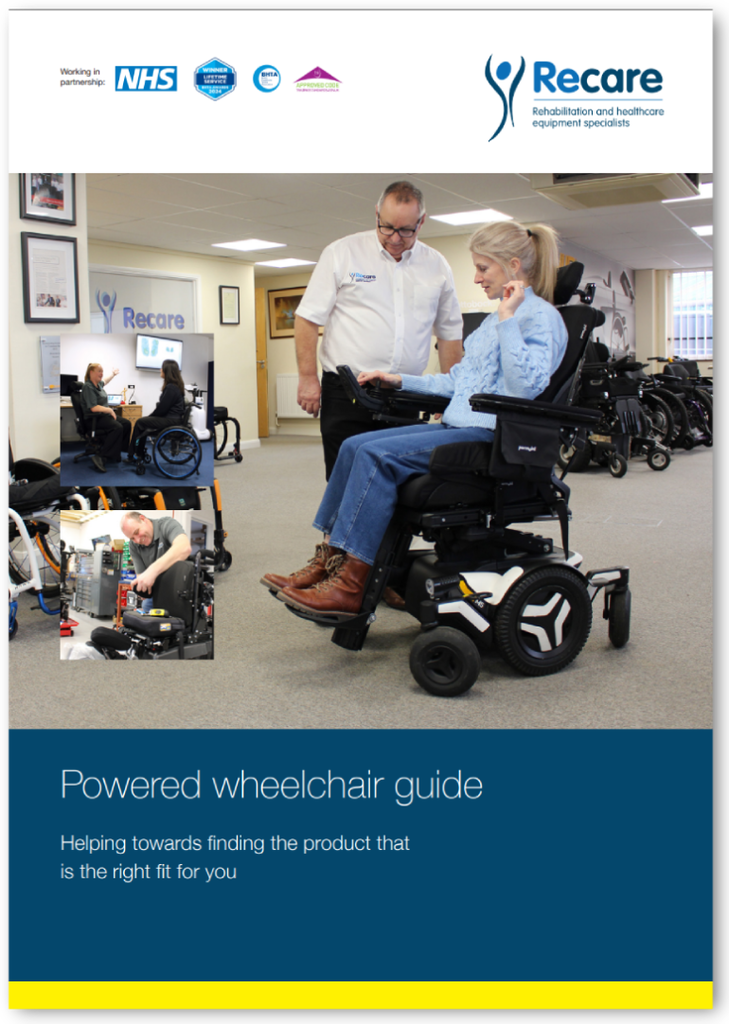
Download our Powered Wheelchair Guide
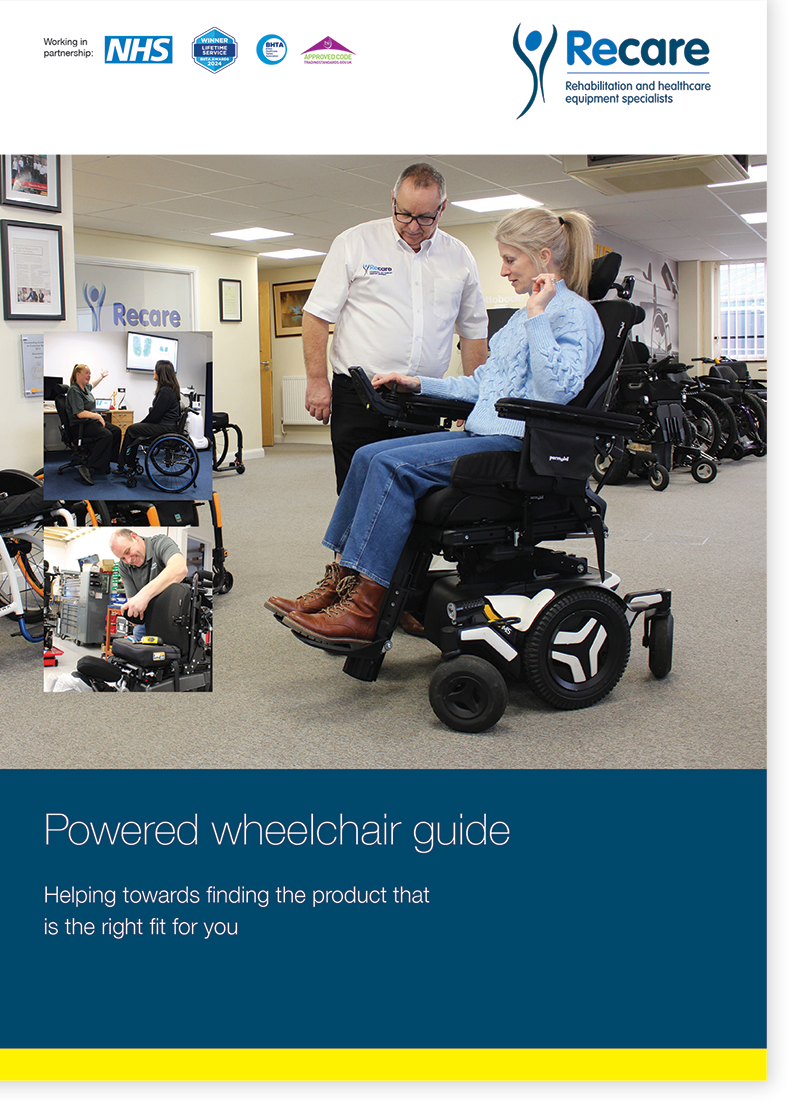
The information in this Powered Wheelchair Guide PDF will help you understand what assistive products might be suitable for you however, we always recommend an assessment by one of our specialist advisors.
Outline of topics covered
- Choosing the right powerchair
- Different types of powerchair functions
- Powerchair functions
- Servicing, repairs and upgrades
Topics you can find in our downloadable guide
Recare provides one of the largest powerchair ranges in the UK. The choice is extensive, which means our Trusted Assessors can assess and recommend exactly the right product for your needs every time. Our clinical specialists and technical engineers can use the latest technology and components to configure powerchairs with unique functionality for any need. We have the products and know-how to provide the answer from basic mobility to advanced controls or postural support for complex needs. The journey to owning the right powerchair for you always starts with an assessment from us. However, before you call us, the following information will help you start to understand the many features available:
Key Takeaways
- Recare offers a wide range of powerchairs in the UK, with tailored assessments for individual needs.
- Different drive configurations include Mid-Wheel-Drive, Front-Wheel-Drive, and Rear-Wheel-Drive, each with distinct advantages.
- Powered wheelchair functions include seat lifts, tilt-in-space, and standing functions, enhancing user comfort and accessibility.
- The powered wheelchair guide explains features such as elevating leg rests, active reach, and memory functions for optimal user experience.
- Advanced models offer extensive programmable options for personalised comfort in the day.
Powered Wheelchair functions
Powerchair Drive Configurations
The drive wheel (large wheel) position determines how your powerchair performs in different environments. Understanding the differences helps identify the most suitable option for your daily needs.

Mid-Wheel-Drive (MWD) Powerchairs
Mid-wheel drive powerchairs have their drive wheels located directly under the user, providing excellent balance and manoeuvrability. With six wheels on the ground (two drive wheels and four casters), they offer a tight turning radius, making them ideal for indoor use and smaller spaces. Modern suspension systems now give mid-wheel-drive powerchairs improved outdoor performance and stability.
Examples include: Karma MID Lectus, Permobil M3 Corpus, and Magic Mobility 360
Front-Wheel-Drive (FWD) Powerchairs
Front-wheel drive powerchairs have their drive wheels positioned at the front, allowing them to climb small obstacles and handle uneven ground effectively. They provide good traction outdoors and a compact turning circle indoors. Although stable and responsive, users should note that fishtailing can occur at higher speeds.
Examples include: Karma EVO Lectus, Permobil F3 Corpus, and Quantum Rehab 4Front
Rear-Wheel-Drive (RWD) Powerchairs
With RWD, the drive wheels are at the rear of the wheelchair, and the two casters are at the front of the wheelchair. This was the original PWC configuration in the world. With advancements in MWD and FWD, it is no longer the standard and is not commonly used. However, some powerchair users have used RWD for years and prefer to stay with this base type. Browse our range of affordable Rear-Wheel-Drive powerchairs online. Such as the Invacare Aviva RX40, Quickie Q500 R Sedeo Pro or the Ottobock Juvo B6 RWD powerchairs, plus many more.
Powerchair Powered Functions Available
Seat lift
Being able to raise the seat of a powered wheelchair provides many practical and lifestyle benefits. These include improved reach, access to cupboards, better visibility and eye-to-eye contact, which is important for maintaining confidence and better mental health. Powered seat lift functionality is rare within NHS-prescribed powerchairs but popular within the private purchasing market.
Tilt-in-space (TIS)
Tilt-in-space allows the entire seat, backrest, and legrests to recline together without altering posture. This provides effective pressure relief while maintaining optimal postural alignment. It’s one of the most clinically beneficial functions for long-term users.
Negative (Anterior) Tilt-in-Space
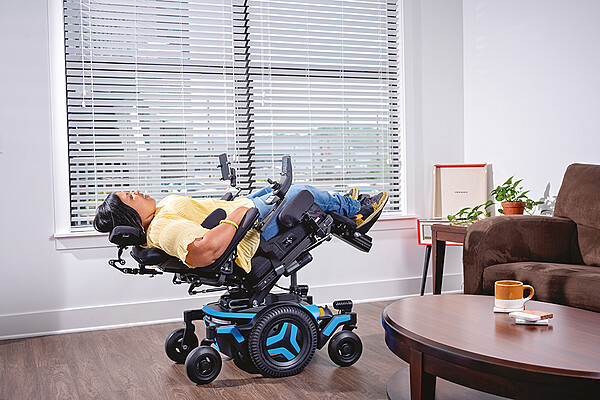
This powered functionality allows the seat to tilt forward. It assists with standing transfers and helps the user lean forward while performing daily tasks. Another advantage is the ability to stretch and exercise safely without standing.
Recline
Recline functionality enables the backrest to tilt backwards, either manually or via a powered mechanism.
An anti-shear powered recline system (such as on many Permobil powerchairs) prevents skin friction during movement — reducing the risk of pressure sores and improving comfort for extended use.
Recline is also beneficial for managing blood pressure, reducing swelling, and allowing rest or personal care while seated.
Elevating leg rests (ELRs)
Elevating or articulating legrests enable users to adjust leg position for comfort, circulation, and functional access.
Advanced systems, such as those on the Permobil M3 Corpus, automatically lengthen to maintain leg alignment and reduce pelvic pressure. This functionality is crucial for pressure management and daily comfort.
Active reach (Posterior Tilt)
Permobil powerchairs, for example, are fitted with programmable elevating leg rests that perform an Active Reach feature. This functionality allows the seat to tilt forward dynamically to support reaching and daily tasks, such as cooking or working at a desk. See more on the Permobil M5 Corpus powerchair, which helps users remain stable and independent without standing.
Standing function
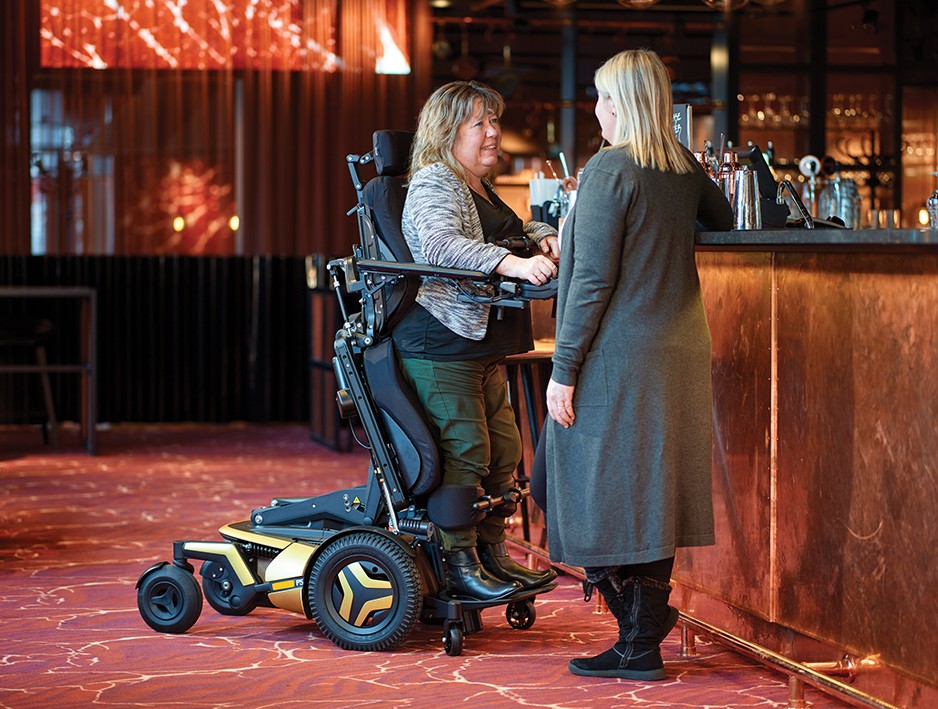
This powered movement can support a user from seated or lying to standing. Permobil provides the optimal sit-to-stand function on the F5 VS powerchair, tailored to specific user ergonomics. The standing function is also an option in the mid-wheel drive Permobil M Corpus VS, with two programmable standing functions – sit-to-stand and lay-to-stand.
Sit-to-stand
This is the most commonly used standing function on a powered wheelchair and allows the user to move from sitting to standing. It means the wheelchair user does not need to be transferred to separate standing equipment, such as a frame, which involves manual moving and handling or hoisting. The ability to stand is essential for many healthcare reasons, such as:
- Relieves pressure and prevents sores
- Improves bowel and bladder function
- Enhances blood circulation and bone density
- Promotes social interaction and eye-level communication
Lay to stand
This function helps a powerchair user who cannot move from sitting to standing. It is beneficial for someone who has not stood for a long time, especially as the process can be closely controlled. Individuals with blood pressure issues can also benefit from changing position, and once standing. All the other associated advantages are available.
Memory functions
Powerchairs, such as the Permobil F5 Corpus powerchair, offer several programmable positions ‘remembered’ by the product. This means they are configurable to move between pre-programmed seating positions such as seated, rest and pressure relief for personalised comfort, selectable by the user throughout the day. Standing functions, if applicable, such as on the Permobil F5 Corpus VS shown in the video above, are also programmable, so both provide a wider range of optimal seating positions unique to the user without having to micro-adjust every time.

Powerchairs
Discover our range of reliable powerchairs designed for independence, comfort and performance. Perfect for everyday use indoors or outdoors, our electric wheelchairs offer smooth handling, advanced controls and lasting comfort for users across the UK.
Mid-Wheel-Drive Powerchair
Permobil M5 Corpus

High-performance powerchair with advanced suspension and comfort.
Mid-Wheel-Drive Powerchair
Quickie Q300 M Mini
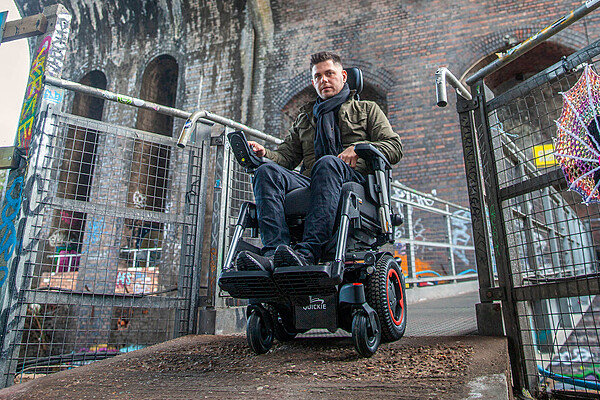
Ultra-compact mid-wheel drive chair ideal for tight spaces.
Mid-Wheel-Drive Powerchair
Magic Mobility 360

Compact all-terrain electric wheelchair for everyday versatility.
Mid-Wheel-Drive Powerchair
Ottobock Juvo B6

Mid-wheel drive powerchair for indoor and outdoor use.
Mid-Wheel-Drive Powerchair
Genny Zero Self-Balancing
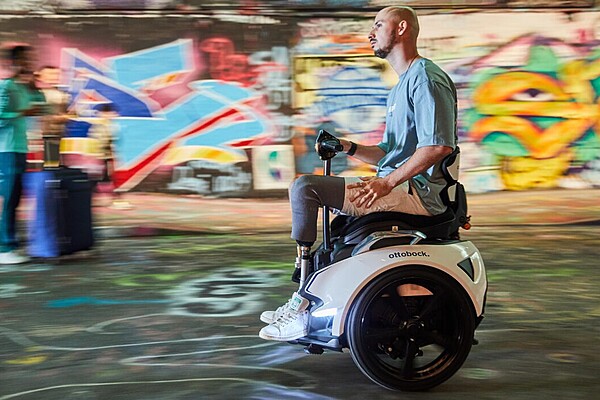
Self-balancing electric wheelchair for hands-free mobility.
Front-Wheel-Drive Powerchair
Permobil F5 Corpus

Premium electric wheelchair with 4-wheel suspension and power tilt.
Front-Wheel-Drive Powerchair
Quantum 4Front 2

Front-wheel drive electric wheelchair with smart stability.
Front-Wheel-Drive Powerchair
Karma EVO Lectus

Customisable powerchair with high-tech seating and support.
Front-Wheel-Drive Powerchair
Permobil F3 Corpus

Compact powerchair for urban mobility and daily independence.
Front-Wheel-Drive Powerchair
Ottobock Juvo B5

Front-wheel drive chair offering traction and smooth control.
Rear-Wheel-Drive Powerchair
Aviva RX40

Sleek rear-wheel electric wheelchair with smart navigation.
Rear-Wheel-Drive Powerchair
Quantum R-Trak

Rear-wheel drive powerchair with rugged outdoor capabilities.
Rear-Wheel-Drive Powerchair
Quickie Q300 R

Rear-wheel drive powerchair for smooth indoor and outdoor use.
Rear-Wheel-Drive Powerchair
Dietz Power SANGO Advanced

Configurable rear-wheel drive chair with soft suspension.
Rear-Wheel-Drive Powerchair
Ottobock Juvo B6

Advanced rear-wheel powerchair for comfort and control outdoors.