![Recare [logo]](https://www.recare.co.uk/wp-content/themes/recare-theme-2021/assets/img/recare-logo-no-strap.svg)
-
Welcome to Recare’s FAQ page.
Clear, helpful answers on choosing, buying, maintaining, and travelling with wheelchairs and mobility equipment.
FAQs
Browse our FAQs below to find the information you need from Recare’s mobility specialists.
If your question isn't answered, feel free to contact our friendly team — we're here to help.
General Questions
Assessments & Clinical Services
Advice, Servicing & Repairs
Funding, Grants & Purchasing
Delivery, Aftercare & Returns
Travelling FAQs
Product and Equipment FAQs
General Questions
What is Recare?
Recare is a UK specialist in mobility and rehabilitation equipment. We supply high-quality wheelchairs, powerchairs, scooters, handbikes, and other assistive products for adults and children. As a family-run business established in 2008, we focus on enhancing independence and comfort through expert advice and tailored solutions.
Where are you based?
Our headquarters are in Oxfordshire (how to find us). We serve customers across the UK with showrooms, home assessments, and nationwide delivery/support. Our team also provides support internationally, due to the respected nature of Recare’s work.
Do you have showrooms?
Yes. You can visit our Oxfordshire showroom to try equipment and speak with our team. The showroom is open Monday to Friday. How to find us.
Our showroom is located on the edge of the Cotswolds, near Blenheim Palace. Five-minute walk from Long Hanborough train station and approximately one hour from London and Birmingham via the M40.
If you are hoping to see specific equipment, please contact us to arrange an appointment. We hold a vast amount of equipment; however, this is used daily for assessments, so it may not be available at all times.
Do you offer products for both adults and children?
Yes. We provide suitable mobility solutions for all ages, including specialist paediatric equipment.
Do you service and repair equipment?
Yes. We provide full servicing, maintenance, and repairs for all the products we supply, giving you peace of mind and extending the life of your equipment. Find out more about servicing FAQs below.
What types of mobility equipment do you offer?
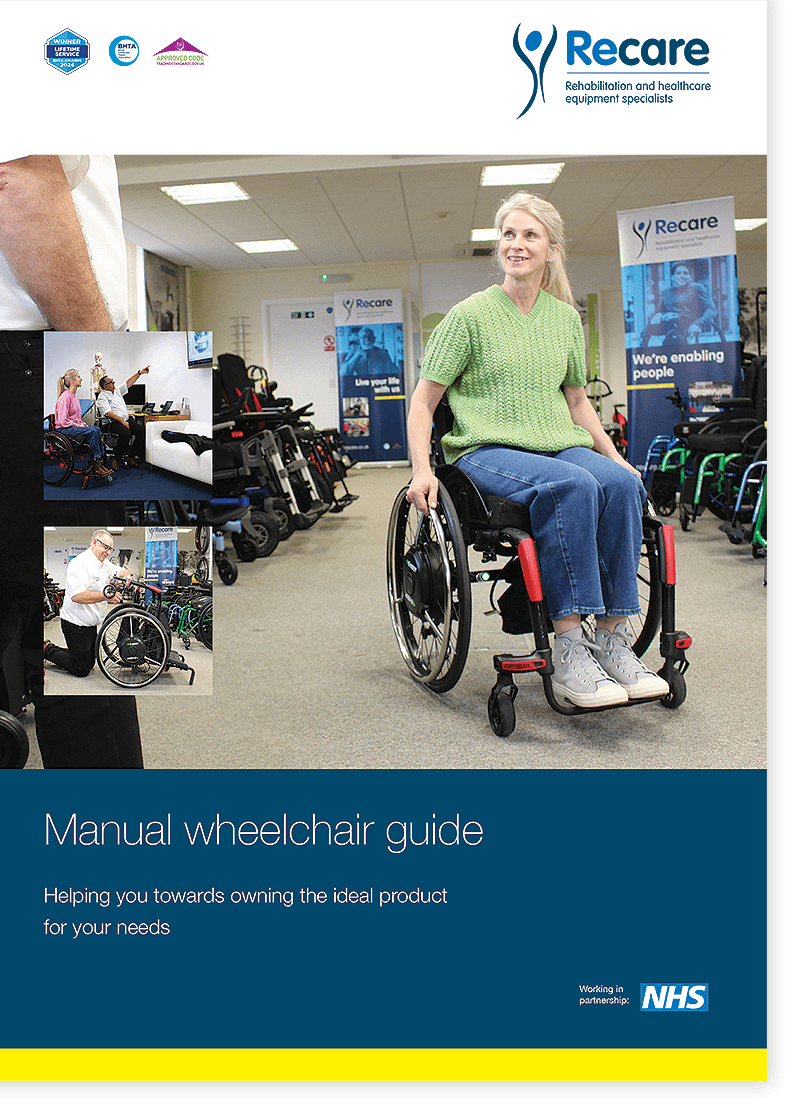
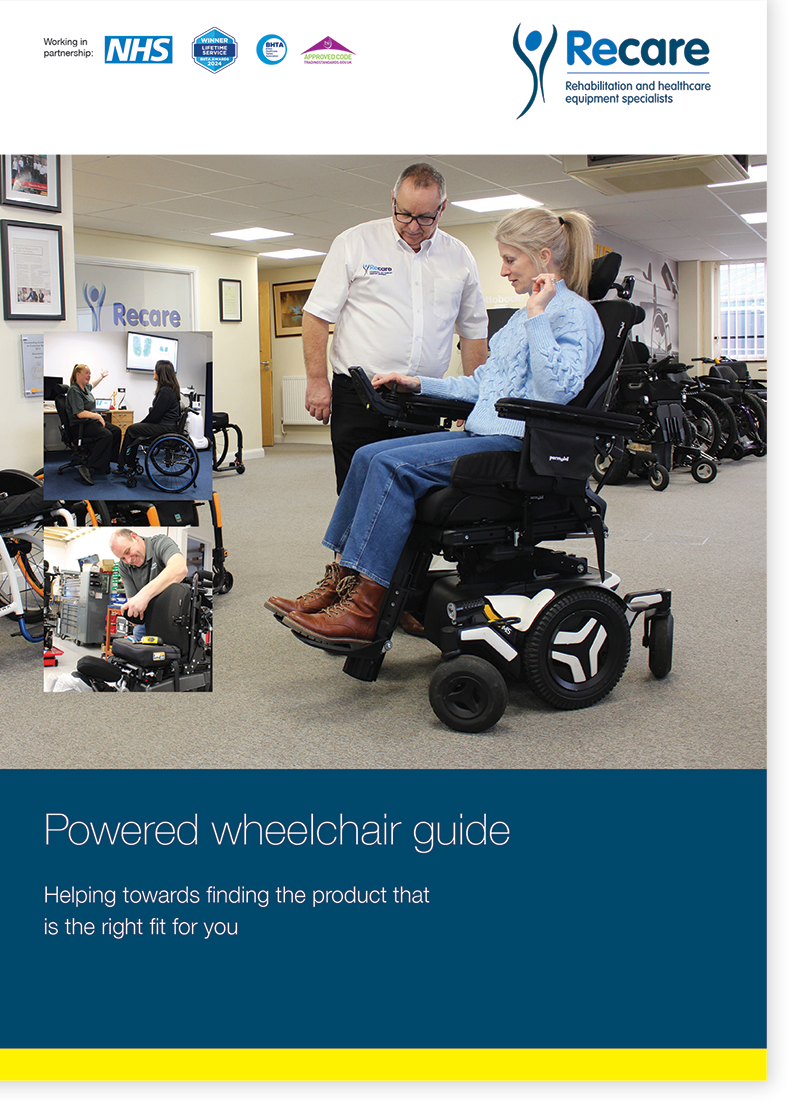
We supply manual wheelchairs, powered wheelchairs, mobility scooters, power add-ons (such as handbikes), beach wheelchairs, weather protection, and a wide range of rehabilitation and daily living aids.
Assessments & Clinical Services
Visit our Servicing & Advice page for more detailed information.
Do you provide home assessments?
Yes. We offer professional assessments (in our showroom or at home) to recommend the most suitable equipment for your needs. If home assessments are not possible, we can arrange a video assessment. Our clinical team provides specialist support for complex requirements. Please speak to us on 01993 880200 to book an assessment.
Do Recare charge for home assessments?
In most cases, no. If home visits require specialist equipment or additional staff and time, we may charge an agreed price for assessments.
What does a professional wheelchair assessment involve?
A professional wheelchair assessment at Recare is a thorough, personalised process designed to match you with the most suitable mobility solution.
During the assessment, our specialist clinicians will evaluate your posture, mobility needs, daily activities, home environment, and long-term goals.
We use pressure mapping technology where needed and offer hands-on trials of different powered wheelchairs, manual wheelchairs, and specialist seating systems. This ensures the final recommendation prioritises comfort, independence, safety, and pressure relief.
The assessment usually takes 60–90 minutes and can be carried out at our Oxfordshire clinic or in your own home. pressure-mapping technology where needed and offer hands-on trials of powered and manual wheelchairs, as well as
What clinical services do you offer?
Our experienced clinicians help with posture management, pressure care, custom seating, and specialist equipment trials. This ensures safe, comfortable, and effective solutions.
Does Recare offer specialist mobility, rehabilitation and educational services?
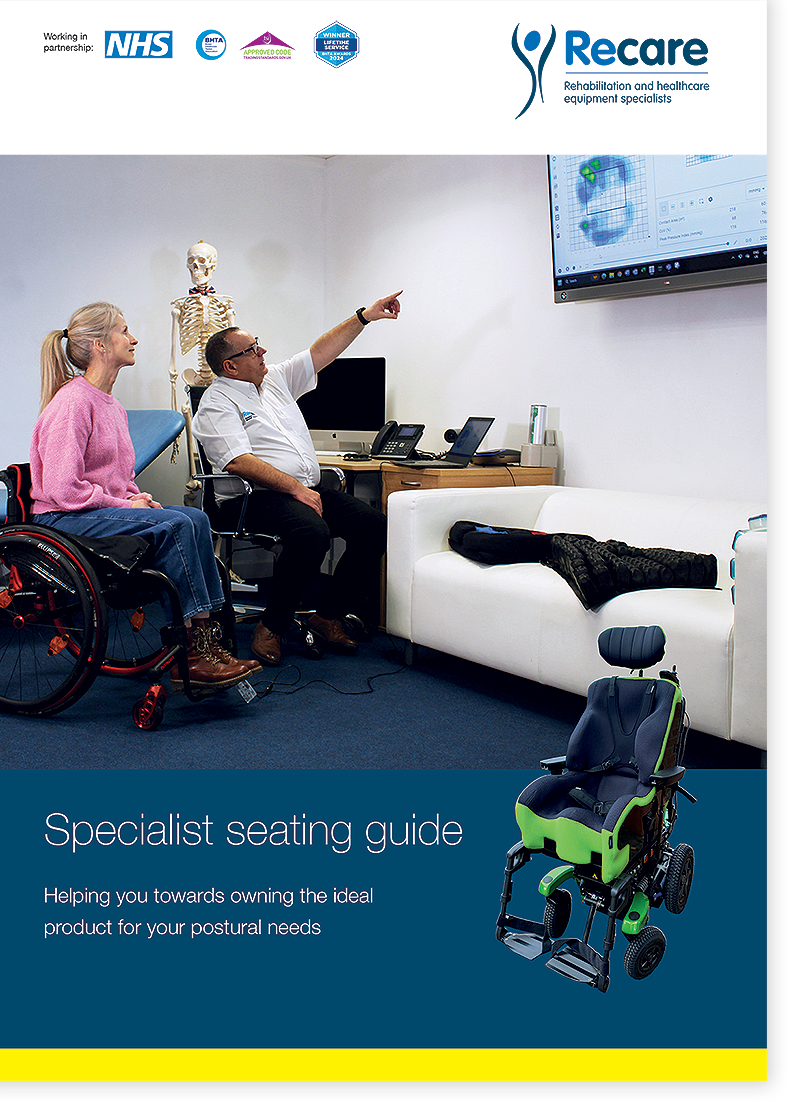
Yes, we work closely with several world-class manufacturers, including Ottobock, to provide specialist assessment services. Our Oxfordshire showroom has a clinical space dedicated to one-to-one assessments for a wide range of products, including carved / moulded seating. We are able to provide specialist pressure mapping services so customised seating can be designed to enhance posture, stability and comfort.
Our headquarters in Witney also provides impressive space for healthcare professional training. Use of these facilities for Continuing Professional Development (CPD) is popular with Occupational Therapists. Access is easy, along with ample parking, and catering can be provided.
In terms of wheelchair services, we have a long-established working relationship with a number of providers – our staff work closely with them to deliver vital support and better outcomes for clients.
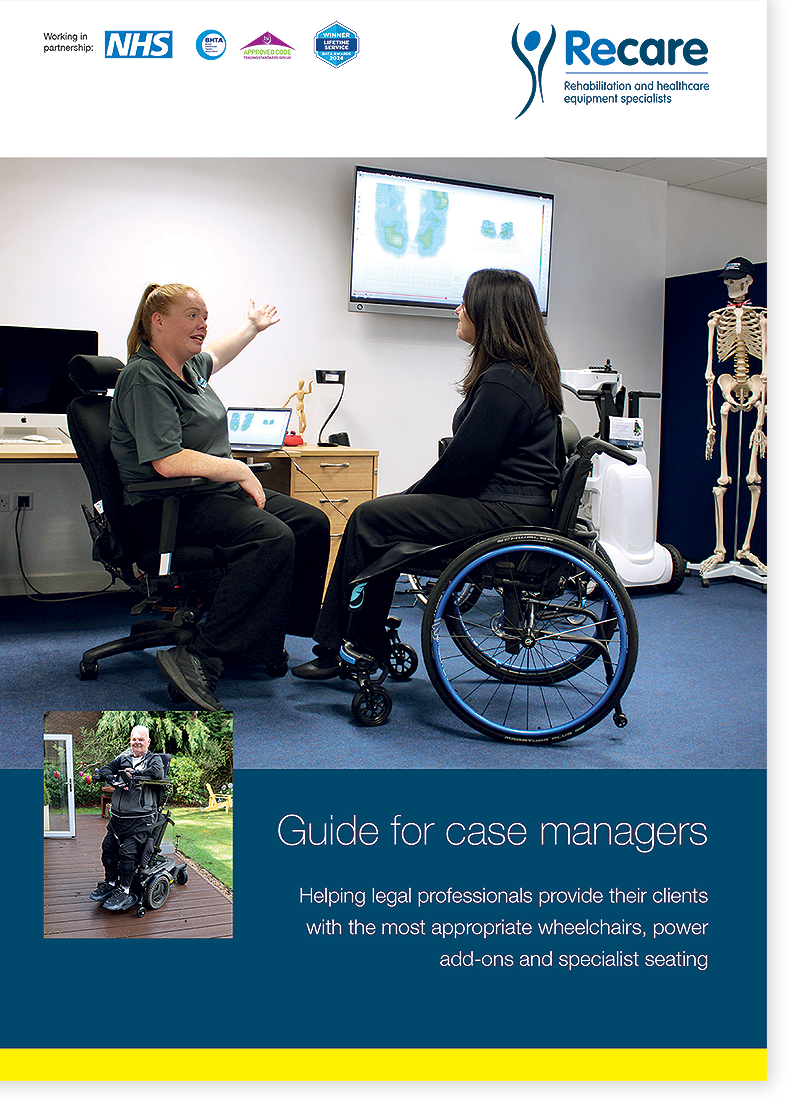
Finally, our specialist services provide a unique advantage to everyone who contacts us, whether consumer or professional. Private therapists, case managers, private individuals, private hospitals, clinics, spinal injury teams and even airlines all benefit from our decades of expertise.
Advice, Servicing & Repairs
Why is my wheelchair not as comfortable as it used to be?
Everyone will experience changing needs as they grow older, their lifestyle adapts or a disability evolves. This can affect the performance and ‘feel’ of your wheelchair or powerchair as it may not be providing the same level of support as it once did. In this case it is best to contact us and we can review and rectify issues by changing product configurations or suggesting new equipment.
How often should I service my wheelchair or scooter?
We recommend regular servicing (typically annually or as specified by the manufacturer) to ensure safety and reliability. Regular servicing is required by the manufacturer to keep your warranty valid.
In some cases, servicing twice a year is recommended, especially for off-road all-terrain powerchairs used in more challenging conditions. Find out more about servicing options or bookings, or contact us.
I am struggling to control my wheelchair following a deterioration in my condition.
If your disability changes or you have a degenerative condition, then your wheelchair might need to be adapted or a different product could be suitable. Please speak to one of our friendly assessors for advice on: 01993 880200.
Funding, Grants & Purchasing
How can I fund my mobility equipment?
Options include self-funding, grants, Disabled Facilities Grants, or schemes like Motability. Our team can advise on the best route for your situation.
Do you accept referrals from professionals?
Yes. We work with healthcare professionals, occupational therapists, and physiotherapists to support their clients.
Delivery, Aftercare & Returns
What are your delivery options?
We offer UK-wide delivery. Many items can be delivered quickly, and larger equipment often includes setup and demonstration. Find out more in our Terms and Conditions.
What is your returns policy?
Please refer to our terms for details on returns. Custom or assessed equipment may have specific conditions. We aim for complete customer satisfaction.
How long does it take to receive my equipment once it has been ordered?
We know how important it is to receive your mobility equipment quickly, so we always work hard to keep lead times as short as possible.
Lead times vary depending on several factors:
- The type of equipment ordered
- Where it is manufactured
- Whether any bespoke adaptations or customisations are required
- Factory shutdowns during peak holiday periods (summer and Christmas)
Once you place your order, we will provide you with a clear estimated delivery timeframe and keep you updated throughout the process.
How do I get support after purchase?
Our team is available for ongoing advice, troubleshooting, servicing, and support. Contact us via phone on 01993 880200 or email info@recare.co.uk.
Travelling FAQs
Can I sit in my wheelchair or powerchair while being transported in a vehicle? / Is my wheelchair crash-tested for travel?
Yes, you can travel while seated in your wheelchair or powerchair, but only if it is crash-tested to the official ISO 7176-19 standard. This standard ensures the wheelchair has passed rigorous safety testing for use as a vehicle seat.
Recare offers a wide range of crash-tested wheelchairs and powered wheelchairs specifically approved for vehicle transport. The best option depends on your individual needs, posture requirements, and the type of vehicle you use.
How to check if your current wheelchair is crash-tested: Look for a crash-test sticker (usually located underneath the seat or on the frame). You should also find detailed instructions about using the wheelchair with vehicle restraint systems in the user manual.
For personalised mobility equipment that is crash-tested for vehicle transport, contact us to discuss with a Recare mobility equipment specialist on 01993 880200 or info@recare.co.uk.
Is insurance compulsory for my wheelchair / mobility scooter?
No, insurance is not a legal requirement; however, we strongly advise customers to take out a specialist policy. Without insurance, you are putting yourself at risk of costly repairs if you have an accident. Equally, you may damage someone else’s property or injure a third party, meaning you are liable to pay for costly repairs and compensation.
Can I take my wheelchair / mobility scooter on a plane?
There are many products available that are suitable for air travel. They are specifically designed to be compact, lightweight and can fold for easy storage on a plane. However, before selecting a wheelchair or scooter for flying, it is important to check that its specification is allowed on a plane. Size, weight and suitability for handling by ground crew will be influential. On electric powerchairs and scooters, the battery in particular is a key component that needs to be checked, in terms of its type and power rating. Some batteries are deemed a potential safety risk on a plane, so will not be allowed on board, either in the cabin or luggage hold.
Every airline has different policies, and ultimately, it is the Pilot’s decision whether equipment is allowed on board or not. Power controls may also need to be isolated before stowage with power cut-off safety plugs. So if you are looking to fly with equipment, telephone our specialist advisors and they will be able to advise on the latest safety legislation – 0330 3202495.
Do I have to register my wheelchair / mobility scooter with the DVLA?
Scooters and wheelchairs fall into two categories – class 2 and class 3.
Class 2 devices are capable of a maximum speed of 4 mph and are only intended for use on a footpath. These devices do not need to be registered with the DVLA.
Class 3 devices are capable of speeds of up to 8mph and are road legal – these have to be registered with the DVLA.
What types of surfaces can I use my wheelchair or mobility scooter on?
Wheelchairs and mobility scooters are designed for many different purposes. Some scooters and wheelchairs are only designed for smooth surfaces. Others are suitable for more challenging terrain. This is why it is essential for you to discuss your intended use with us so we can advise on the right product. In most cases, it is sensible to consider purchasing equipment that is capable of more than you need it to do.
Why does my powerchair not travel as far as the manual states on a single charge?
Firstly and most importantly, the distance stated in an owner’s manual is a hypothetical maximum that is calculated under test conditions. It is almost impossible for you to use your mobility equipment, e.g., a scooter or powerchair, on a daily basis in conditions that would match a test environment.
In real-world situations, a number of factors will affect the distance that you are able to travel with your mobility equipment, e.g. scooter or powerchair. These include outside air temperature, tyre pressure, user weight, type of terrain, age and condition of batteries, etc.
How you charge your batteries also directly affects how your batteries perform. It’s easy to understand that you can undercharge your batteries by not charging them enough, but did you know that it is also possible to overcharge your batteries by charging them too much? Overcharging batteries can have the same effect as undercharging them. Please speak to one of our Recare engineers regarding the best way to charge your batteries.
Product and Equipment FAQs
For answers to specific product and equipment questions, visit our useful guides page.
Still have questions?
If we haven't provided an answer to your question on this page, call us 01993 880200 or email
info@recare.co.uk.