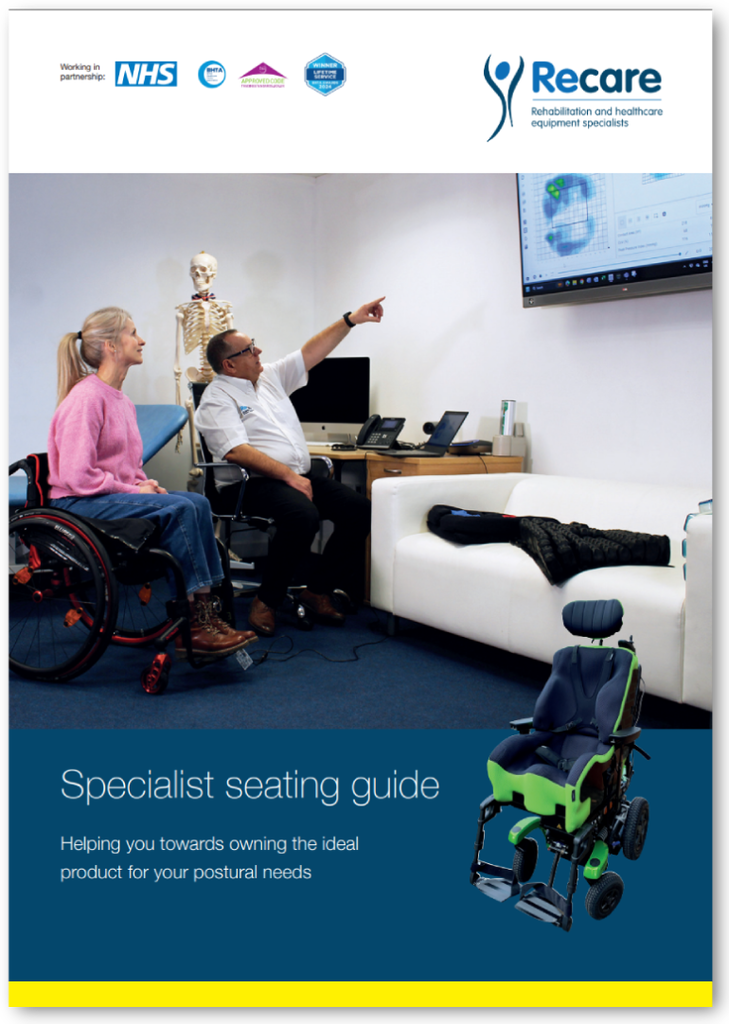
Download our Specialist Seating Guide
Recare’s Specialist Seating Guide provides a clear, practical introduction to help users, families, carers, and therapists understand the main types of specialist seating and why a professional assessment is essential.
Why Healthy Posture Matters
When sitting for long periods without adequate support, many people develop poor postures such as sacral sitting (posterior pelvic tilt), windswept positioning, or excessive lumbar lordosis. These can lead to discomfort, fatigue, compromised breathing and digestion, increased pressure-sore risk, and reduced ability to interact socially or perform daily tasks.
A well-fitted specialist seat creates a stable base, promotes neutral pelvic positioning and spinal alignment, and helps users feel more confident, positive, and engaged with the world around them.
Main types of Specialist Seating covered in the guide
The guide looks at three broad categories of specialist seating:
1. Moulded (Bespoke) Seating
Ideal for users with complex, asymmetrical postures (e.g., scoliosis, pelvic obliquity, or significant deformities). These seats are custom-carved or moulded directly around the individual for maximum body contact, support, and pressure distribution. Brands like Ottobock are commonly used for foam-carved solutions.
2. Modular (Measured/Adjustable) Seating
Highly versatile systems made up of adjustable components such as trunk supports, lateral supports, thigh guides, and pommels. These are excellent for growing children, users with changing conditions, or those who need ongoing adjustability. The modular approach allows fine-tuning over time without replacing the entire system.
3. Off-the-Shelf / Made-to-Measure Solutions
High-quality standard or semi-custom options are available in a wide range of sizes. These often include advanced cushions in Air, Gel, or Foam constructions, along with backrest systems (such as NXT backrests) that provide excellent lateral support and comfort for many users.
Key Technologies & Assessment Tools
The guide highlights the value of pressure mapping - a clinical tool used at Recare’s clinic to identify high-pressure areas and design cushions/seats that reduce the risk of pressure sores while maximising comfort. This data-driven approach helps create truly personalised solutions.
The Recare Process
Recare emphasises a thorough, client-centred approach:
- Initial consultation (phone or in-person)
- Posture assessment
- Trial of demonstration equipment (for modular solutions)
- Detailed recommendations
- Ordering, configuration, and professional handover
Note: For growing children or users with progressive conditions, regular reviews ensure seating remains effective and adaptable.
Ready to Improve Your Posture and Comfort?
Recare’s Specialist Seating Guide serves as an excellent starting point to understand your options. It covers the benefits of different seating types, the importance of proper posture, pressure management, and what to expect from a professional assessment.
Download the full Specialist Seating Guide for free
Download the full Specialist Seating for free below or contact Recare today to arrange a no-obligation assessment. Our team specialises in tailoring solutions to your unique needs.
"*" indicates required fields